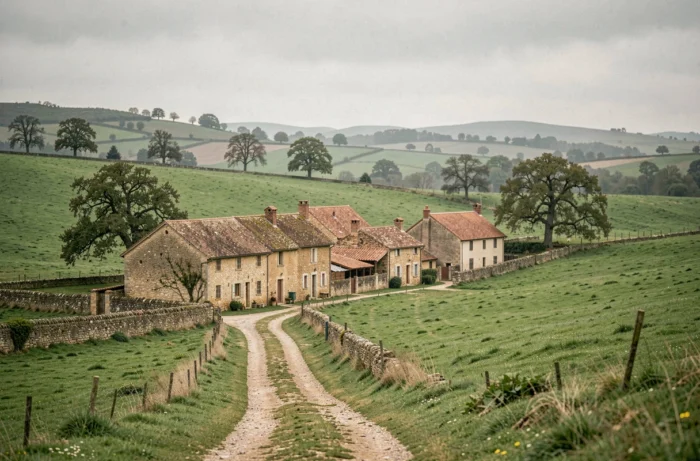
Hamlet, place-name, village: these three terms refer to distinct spatial realities, but none has a fixed legal definition in the general code of local authorities. Their differentiation is based on a set of criteria (size, facilities, built organization) specified by administrative case law and ministerial responses. Understanding what separates these concepts also means measuring their concrete consequences in terms of urban planning, addressing, and daily life.
Comparative Table: Hamlet, Place-name, and Village
The criteria for distinction have never been the subject of a single legal article. The table below synthesizes elements from the Senate’s response of March 15, 2007, and current administrative practice.
| Criterion | Place-name | Hamlet | Village |
|---|---|---|---|
| Nature | Cadastral toponym designating a plot or micro-sector | Small group of houses isolated from the town | Larger grouping, structured around collective facilities |
| Number of buildings | May contain no dwellings (field, woods, crossroads) | About ten to fifteen buildings at most | Greater than a hamlet, with no fixed national threshold |
| Collective facilities | No requirements | Not necessary (neither commerce nor public service) | Includes or has included religious, administrative, or commercial facilities |
| Administrative status | None (cadastral reference) | No specific status, attached to a municipality | No specific status, attached to a municipality |
| Role in addressing | Optional address complement since the 3DS law | Optional address complement since the 3DS law | May name a main road |
The place-name is clearly distinct from the other two categories: it does not necessarily designate a built grouping, but a toponym linked to the cadastre. A place-name can correspond to a wood, a path, or an old mill without any dwelling remaining.

To delve deeper into the definition of a hamlet and its concrete implications in real estate, the distinction with the village primarily rests on the past or present presence of collective facilities.
Absence of Legal Definition: What Case Law Says About Hamlet and Village
The ministerial response published in the Senate on March 22, 2007, remains the most cited reference by administrative courts. It specifies that the size and organization of hamlets depend on local traditions, making any uniform national definition impossible.
This deliberate ambiguity has a direct consequence in urban planning law. In municipalities subject to the Mountain Law, the distinction between hamlet and village determines the right to build. The extension of urbanization can only occur in continuity with existing towns, villages, and urban areas. A hamlet, according to case law, does not necessarily constitute a sufficient support point to justify new constructions.
The administrative judge assesses on a case-by-case basis. They examine the density of buildings, the distance between constructions, and the presence of network access. A group of four houses scattered on a hillside will not be classified as a hamlet, whereas eight dwellings grouped around a common path may be.
The village is recognized by its facilities, even if they have disappeared
A often overlooked point: a village remains a village even if its school, church, or shop has closed. The Senate’s response explicitly mentions that facilities may no longer be in service. The longevity of collective structuring is sufficient to distinguish the village from the hamlet.
This interpretation has concrete effects on local urban planning documents. Municipalities classify sectors differently depending on whether they identify a village (where measured extension may be authorized) or a simple hamlet (where construction possibilities are more restricted).
3DS Law and Addressing: The Place-name Loses Its Role as Main Address
Law No. 2022-217 of February 21, 2022, known as the 3DS law, has made the naming of roads and the numbering of dwellings mandatory for all French municipalities. Before this law, many rural municipalities operated with addresses composed solely of the place-name, without a number or street name.
The triplet “number, street name, municipality” is now the reference structure in the local address database. The place-name becomes an optional complement. This technical evolution alters the daily perception of these micro-territories for the affected residents.
The municipal council remains decision-making
The 3DS law does not require the removal of place-names from addresses. It leaves the municipal council the choice to retain or not the toponym as a complement. Some rural municipalities have adopted new street names while keeping the place-name in parentheses. Others have opted for a completely renovated addressing system, sometimes causing confusion among residents attached to their old toponym.
The criteria prompting a municipality to modify its addressing are multiple:
- Improvement of emergency services’ intervention, which struggle to locate a dwelling identified solely by a place-name without a number
- Compliance with national databases (national address database, La Poste, cadastre)
- Simplification of deliveries and administrative procedures for residents

Toponyms and Cadastre: Why Place-name Names Persist
Place-names derive their names from geographical characteristics, former agricultural uses, or forgotten surnames. A place-name “Les Bois” refers to a forest cover, “Le Chemin de Saint-Paul” to an old route, “La Fontaine” to a cadastral water point. These toponyms are recorded in the Napoleonic cadastre and remain active land references, regardless of postal addressing.
The persistence of these names in everyday language exceeds their administrative utility. In the Alps, in Charente, or in newly merged municipalities, residents continue to refer to their neighborhood by the original place-name, even when the official address has changed.
This overlap between the old and the new sometimes creates ambiguities. A letter addressed to “Moulin de la Route” may reach its destination in a small municipality where the postman knows each resident, but fail in an automated sorting system that recognizes only the standardized number and street name.
The distinction between hamlet, place-name, and village is not merely a vocabulary exercise. It conditions the rights to build in mountain areas, the way an address is structured since the 3DS law, and the emotional relationship of residents to their territory. French law has chosen not to fix these notions in a rigid national definition, leaving local traditions and the administrative judge to adapt the criteria to each situation.