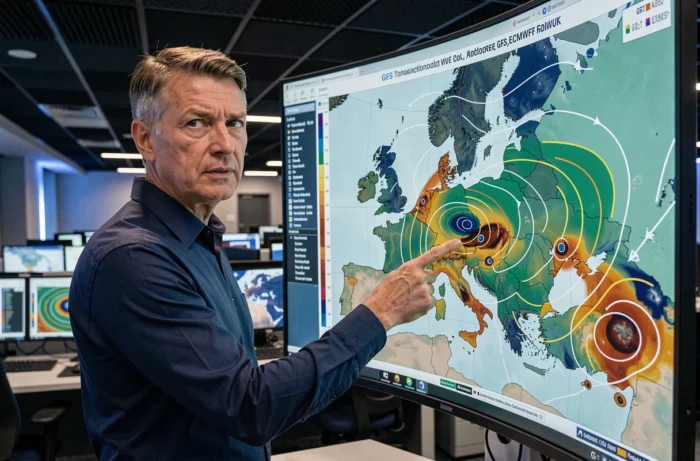
Two weather forecasting models dominate discussions among professionals and enthusiasts in Europe: the American GFS and the European ECMWF, often referred to as “Euro.” Their respective reliability fuels ongoing debates, especially since verification methods and the chosen forecasting horizons radically change the conclusions. The arrival of artificial intelligence forecasting systems within the ECMWF redefines the terms of this comparison.
Resolution and grid size: what GFS and ECMWF measure differently
The grid size determines a model’s ability to represent local phenomena. The ECMWF (via its IFS model) uses a finer grid than the GFS over Europe, allowing it to better capture the terrain, coastal contrasts, and tight thermal gradients. The GFS, on the other hand, covers the globe with a coarser grid, suitable for a synoptic view but less precise on regional details.
This difference in resolution has direct consequences on precipitation and temperature forecasts in mountainous or coastal areas. A coarse grid model tends to smooth out local extremes, while a tighter grid better captures orographic effects. For users in France or Western Europe, the comparison between GFS and Euro in Europe often favors the ECMWF for short to medium-term forecasts, precisely because of this resolution.
Resolution does not explain everything. The assimilated observation data (ground stations, weather balloons, satellites, radars) also differ from one system to another. The ECMWF benefits from a dense network of European observations, which enhances the quality of its initial analysis in this geographical area.

Medium-term forecasts: where the ECMWF pulls ahead of the GFS
The ECMWF generally outperforms the GFS between three and seven days ahead for Europe. It is on this horizon that evaluations converge most clearly. The ECMWF ensemble system, which generates dozens of slightly perturbed scenarios, provides an uncertainty estimate that forecasters consider more calibrated than that of the GFS.
Beyond seven days, both models lose reliability, but the ECMWF maintains a measurable advantage on pressure fields and temperatures at 500 hPa. Ground reports diverge more on long-term precipitation, where both models show sometimes comparable biases.
The ECMWF has continued to improve its IFS model through targeted changes in parameterization and data assimilation. An evaluation covering summer 2024 and winter 2024-2025 reported an improvement in temperature and geopotential forecasting over the Northern Hemisphere. These adjustments, often invisible to the end user, help maintain the gap with the GFS.
AIFS: when artificial intelligence changes the game for the European model
The classic comparison between GFS and ECMWF is based on physical models, meaning software that solves the equations of atmospheric thermodynamics. The ECMWF has added a new dimension by operationalizing its AI forecasting system, called AIFS.
The deterministic version AIFS Single was put into production on February 25, 2025, followed by the ensemble version AIFS ENS on July 1, 2025. The European operational offering now includes two parallel approaches: traditional physical modeling and machine learning. The GFS does not currently have an operational equivalent integrated in this way.
The interest of this dual approach goes beyond the simple gain in verification scores. In September 2025, the AIFS system was incorporated into the EFAS, the European Flood Awareness System, to complement physical forecasts in a multi-model chain. This integration into an operational alert system marks a shift in scale compared to AI demonstrators tested elsewhere.
Known limitations of AI forecasts in meteorology
AI models like AIFS learn from historical reanalyses. Their ability to anticipate unprecedented events without recent climatic precedent remains an open question. The available data do not allow for concluding that AI will replace physical modeling across all parameters, particularly localized convective precipitation.
The ECMWF itself maintains both systems in parallel, suggesting that complementarity takes precedence over substitution for now.
Model verification: comparing GFS and ECMWF with the right metrics
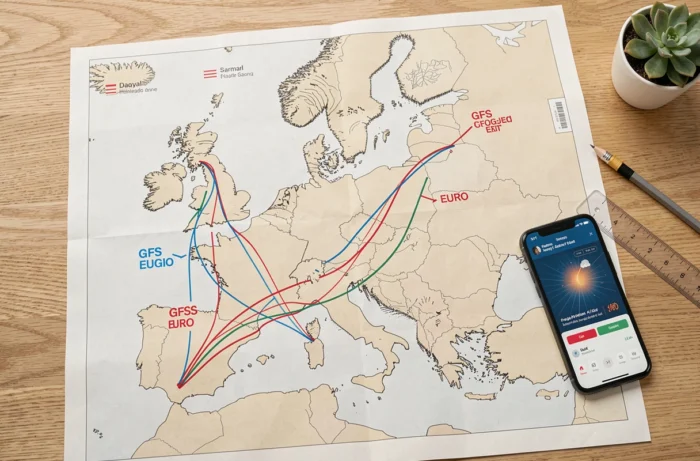
Claiming that one model “is better” without specifying the metric, variable, and geographical area makes no operational sense. The most common verification scores focus on variables such as:
- The geopotential at 500 hPa, which reflects the quality of the forecast of general atmospheric circulation and where the ECMWF regularly shows better scores over Europe.
- Cumulative precipitation, a parameter more difficult to verify because it is highly variable locally, and where the differences between models decrease for short-term forecasts.
- Temperature at 2 meters, sensitive to the representation of the ground and vegetation cover, a domain in which resolution plays a direct role.
Public comparison platforms allow for comparing the outputs of several models (ECMWF, GFS, ICON, UKMO) at the same geographical point. These tools make verification more accessible, but overall scores sometimes mask very different performances depending on regions or seasons.
Why simplified comparisons can be misleading
One model may excel in Atlantic storms and perform poorly in Mediterranean episodes. The GFS performs better than the ECMWF in certain synoptic configurations over North America, which says nothing about its reliability in Europe. Overall rankings have limited utility if the geographical and seasonal context is not specified.
For a user located in France or Western Europe, the ECMWF remains the reference model for medium-term forecasting. The GFS retains its value as a second opinion, especially when the two models diverge significantly, signaling a real meteorological uncertainty rather than a simple flaw in one of the two systems. Consulting both in parallel remains the most reliable practice for anticipating atmospheric developments on the continent.