
A lease that ends in three weeks, an attic saturated for years, and a kitchen still full: emptying a home quickly requires making swift decisions about each item without wasting time on unnecessary back-and-forths. The difficulty is not just physical. It mainly lies in the order of operations and the legal traps that most guides overlook.
Inheritance and Home Clearance: The Legal Trap Before the First Box
It is often thought that one can start clearing out immediately after a death or a verbal agreement among heirs. In reality, any act of disposition regarding the assets of an estate can be considered acceptance. Giving away furniture, throwing out archives, selling dishes, even as a favor, can deprive another heir of their rights and engage your liability.
Before touching anything, secure the legal framework. This involves a validated inventory, unanimous agreement among heirs, and written documentation sent to the notary. Without these steps, a quick clearance can turn into a family dispute that lasts for months.
This point is rarely addressed in articles about decluttering, but it conditions everything else. If the home to be cleared is related to an inheritance, start with the notary, not with the boxes. You can also find C Ma Déco’s tips for clearing a home which highlight the importance of framing the project in advance.
Waste Sorting in Home Clearance: What the AGEC Law Changes Practically
Since January 1, 2024, the AGEC law mandates source separation of bio-waste for all holders, with no tonnage threshold. Practically, when clearing out a kitchen or a cellar, one can no longer mix food scraps, expired canned goods, and household waste in the same trash bag.
During a home clearance, the amount of food waste forgotten in cupboards, the freezer, or the cellar is always surprising. It is necessary to plan for a separate sorting flow from the start, with a dedicated container for bio-waste.
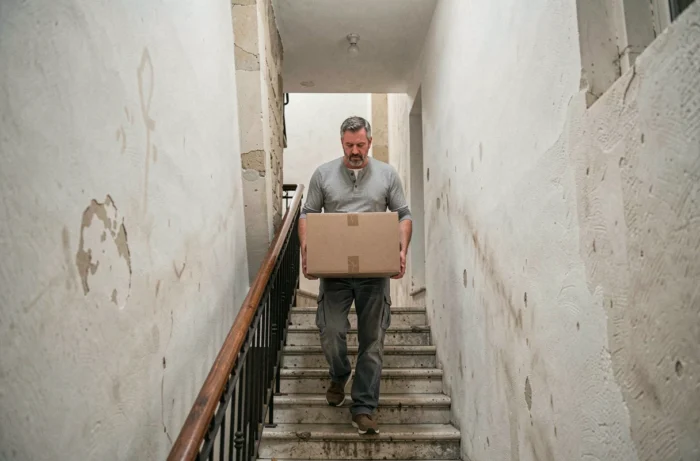
For bulky items (broken furniture, mattresses, large appliances), the rules vary by municipality. Some offer collection by appointment, while others require drop-off at a recycling center. Checking this point before starting avoids ending up with a cluttered sidewalk and a fine.
- Bio-waste (food scraps, peels found in cupboards): separate container, specific collection, or neighborhood composter depending on the municipality.
- Bulky items (furniture, bedding, non-functional appliances): collection by appointment or drop-off at a recycling center, never loose on the sidewalk.
- Waste from electrical and electronic equipment: mandatory take-back by the retailer upon equivalent purchase, or drop-off at an approved collection point.
- Textiles and clothing: dedicated collection bins, even for damaged items (they are recycled into insulation or industrial rags).
Room-by-Room Method: Start with Low Emotional Load Areas
Always start with rooms where there are no attached memories: the bathroom, the toilet, the pantry, the garage. These spaces clear out quickly because decisions are binary. An opened cleaning product, you throw it away. Duplicate tools, you give away or sell.
Clearing these rooms first creates a buffer zone to temporarily store what comes out of more complex rooms (bedrooms, living room, office). Without this transit space, boxes pile up in the entrance and block circulation.
Sorting Management in Living Areas
For the living room or bedrooms, set up three zones on the floor: keep, give/sell, throw away. Each item goes through a simple question: does anyone need it in the next six months? If the answer is unclear, the item goes into the “give” zone.
Feedback varies on the appropriate duration per session. Some prefer short slots of two hours, while others progress better over a full day. What matters is to finish each room before starting another. Sorting started in three rooms simultaneously never gets completed.
Sale, Donation, and Professional Clearance: Choosing the Right Channel for Each Item
Not everything can be sold, and not everything can be given away either. Furniture in good condition finds buyers on peer-to-peer sales platforms within a few days if the price is realistic. For valuable items (jewelry, paintings, silverware), consulting an auctioneer or a specialized antique dealer is more reliable than an online estimate.
Donations work well for functional appliances, clothing in decent condition, and complete dishware. Local charities often pick up on-site if the volume justifies it, which avoids multiple trips to the recycling center.

When to Call a Clearance Service
A professional clearance service becomes relevant when the volume exceeds what one can manage alone in a few days, or when the timeline is very short. The service generally includes sorting on-site, removal, recycling, and sometimes final cleaning.
- Request a quote after an on-site visit (remote estimates almost always underestimate the actual volume).
- Check that the provider issues a certificate of destruction or recycling for regulated waste.
- Compare at least two quotes: price differences can be significant depending on the region and time.
A properly cleared home rents or sells faster, and the restoration costs decrease when cleaning follows immediately after clearance. Anticipating the sequence of sorting, removal, and cleaning on a tight schedule remains the best way to prevent the project from dragging on.