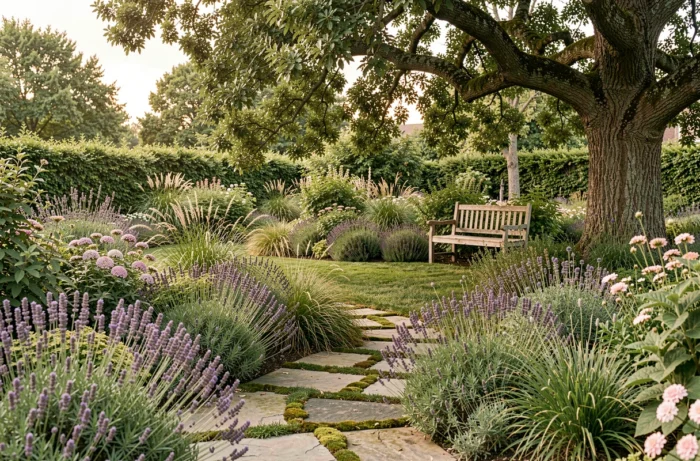
Designing a harmonious landscape garden requires combining data that is rarely considered together: plant style, soil type, regulatory constraints, and long-term maintenance budget. Rather than listing decorative ideas, this article compares the measurable parameters that differentiate a resilient garden from a design that wears out in just a few seasons.
Dry garden, ecological garden, or flowering meadow: comparison of the three dominant styles
According to La Passion du Paysage, the three most requested styles in France for the period 2024-2026 are the ecological garden, contemporary garden, and dry garden. The latter follows a pragmatic logic: to provide an aesthetic result with minimal maintenance. The flowering meadow, identified as a key trend for 2024-2025, is described as the “signature of the natural garden” by the same source.
The table below summarizes the concrete differences between these three approaches for an average residential plot.
| Criteria | Dry Garden | Ecological Garden | Flowering Meadow |
|---|---|---|---|
| Watering | Very low (Mediterranean plants, grasses) | Moderate (mulching, water recovery) | Almost none after establishment |
| Annual maintenance | Low (occasional pruning, limited weeding) | Medium (rotation, composting, gentle pruning) | Very low (one to two mowings per year) |
| Encouraged biodiversity | Medium (pollinating insects) | High (beneficial wildlife, living soil) | High (pollinators, birds) |
| Heatwave adaptation | Excellent | Good if local species | Variable depending on the sown mix |
| Relative installation cost | Medium to high (mineral, perennials) | Medium (amendments, diverse plants) | Low (seeding) |
The dry garden stands out for its resistance to drought episodes, an increasingly decisive criterion. In contrast, the flowering meadow offers the best cost of installation/biodiversity ratio for large spaces. The choice between these options directly depends on the available area, exposure, and soil type.
Specialized resources allow for refining this diagnosis on a case-by-case basis, such as those available on jardinsetpayssages.com, which detail the suitable plant combinations for each configuration.

Soil and exposure: the data that condition all landscaping
Clay soil is not planted like sandy soil. This obvious fact is, however, absent from most landscaping guides, which jump straight to decorative suggestions without first establishing an agronomic diagnosis.
Identifying soil type without a laboratory
The ribbon test remains the most accessible method. Take a handful of moist soil and roll it between your palms. If it forms a soft ribbon without cracking, the soil is clayey. If it crumbles immediately, it is sandy. In between, you have loamy soil, generally the most versatile for a landscape garden.
- Clay soil: favor deep-rooted perennials and drainage by adding gravel at the base of the bed. Mineral mulching limits surface compaction.
- Sandy soil: enrich with organic matter (compost, decomposed manure) to improve water retention. Ornamental grasses and lavenders thrive naturally here.
- Loamy soil: the most fertile, but sensitive to compaction. Avoid working the soil when it is waterlogged, and always cover with organic mulch.
Exposure determines the plant palette much more than personal taste. A south-facing area in a continental climate requires plants that are resistant to heat and frost. A damp north-facing facade calls for ferns, hostas, or hellebores, not roses.
Biodiversity regulation: what the 2026 hedge decree changes for private gardens
Decree No. 2026-829 of August 28, 2026, concerning the unique hedge regime, modifies the rules applicable to hedges in France. This text establishes a declarative framework and cutting prohibitions that also concern individuals, depending on neighborhood configurations.
Beyond hedges, the destruction of nests or habitats of protected species in a private garden can be punished by up to 3 years in prison and a fine of 150,000 euros under the Environmental Code. This legal risk directly concerns landscaping work: pruning during nesting periods, uprooting old hedges, removing piles of wood or stones harboring reptiles.
Concrete precautions before excavation or planting work
- Check for active nests before any pruning or felling between March and August. If in doubt, postpone work until after the nesting period.
- Preserve existing hedges as much as possible: they constitute ecological corridors protected by the new declarative regime.
- Document the initial state of the land (dated photos) to prove the absence of protected habitat in case of inspection.
A landscaping project compliant with biodiversity regulations is not an aesthetic option; it is a legal obligation whose non-compliance exposes one to severe penalties.

Climate resilience of the landscape garden: adapting plants to repeated heatwaves
Trees and hedges planted in 2025 to create cool islands dried out during subsequent heatwave episodes, as reported by several testimonies relayed by the press. The problem is not the planting itself, but the choice of unsuitable species and the lack of watering follow-up during the first two years.
Mediterranean plants and local species resist better than imported horticultural cultivars. The dry garden mentioned earlier derives its relevance from this climatic reality. Combining evergreen shrubs (cistus, rosemary, phillyrea) with ornamental grasses creates a plant structure capable of enduring several weeks without rain.
Mulching plays a measurable role in moisture retention at the base of the plants. A thick organic mulch (wood chips, branch shreddings) significantly reduces evaporation, whereas bare soil loses its moisture within a few days of intense heat.
The composition of a harmonious landscape garden is now determined as much by resistance criteria as by aesthetic considerations. A bed that survives three consecutive summers without supplemental watering has more landscape value than a spectacular flowerbed that needs to be replanted every autumn. Local climatic data, soil type, and regulatory framework form the triangle of constraints to be resolved before choosing any plant.