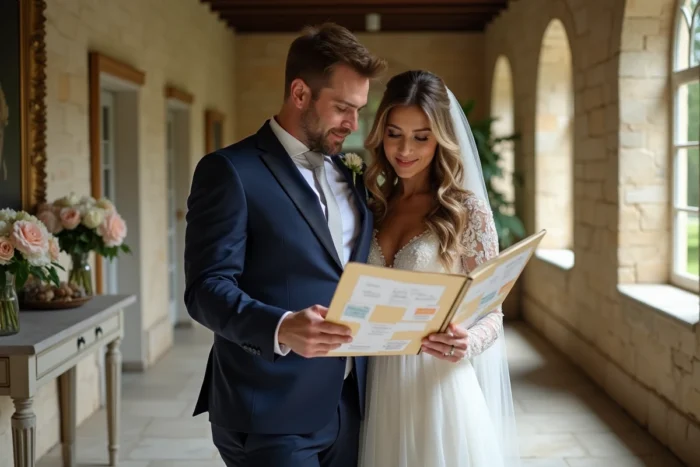
Organizing a wedding without stress involves addressing a rarely mentioned issue: the mental load that weighs on the couple far beyond simple planning. Family pressure, ongoing financial negotiations, accumulated fatigue on the big day – the sources of tension go well beyond logistics. Here are ten practical tips, focused on what truly generates stress, to prepare a ceremony that meets your expectations without exhausting you.
1. Share the mental load with a shared responsibility chart

The majority of tensions in a couple during the preparation period stem from an invisible imbalance: one person carries almost all the decisions. A shared spreadsheet (Google Sheets, Notion) with three columns – task, responsible person, deadline – makes this load visible and divisible.
Assign each role (caterer, flowers, music) to a single person. The rule: the one managing a role makes the final decision without needing the other’s approval. This mechanism reduces back-and-forth and micro-conflicts that wear down the couple over time.
2. Set a budget ceiling for each category before searching for vendors

Many couples set a global budget and then discover overruns category by category. The reverse method works better: assign a firm ceiling to each category (venue, caterer, photography, decoration, attire) before even contacting a vendor. To delve deeper into this approach, the tips on Planifiez votre Mariage detail a prioritization grid adaptable to each budget.
Then, rank your categories into two levels: those on which you refuse to compromise and those where you are open to negotiation. Prioritizing a maximum of three categories as non-negotiable prevents the escalation effect where each budget line chips away at the next.
3. Create a reverse timeline starting from the big day

A classic timeline starts from the engagement date. A reverse timeline starts from the big day and works backward month by month. This approach forces you to identify non-negotiable deadlines: venue booking (often twelve months in advance for popular sites), sending invitations, fittings.
First, place the fixed deadlines, then fill in the gaps. Tasks without a firm deadline (choosing stationery, playlist) should be scheduled in the free slots, not as a last-minute rush the week before.
4. Appoint a day-of coordinator separate from the couple

On the wedding day, the couple should not manage any logistics. Designate a witness, an organized friend, or a professional coordinator who has a single document: the hour-by-hour schedule with contacts for each vendor.
The couple does not answer any logistical questions on the big day. Any request (florist delay, guest seating, sound issues) goes through the coordinator. This simple rule transforms the experience for the couple.
5. Include recovery breaks in the schedule for the big day

Wedding timelines often string together ceremony, photos, cocktail, meal, and evening without a break. Planning two thirty-minute recovery breaks (one after the ceremony, one between the meal and the evening) where the couple can isolate themselves radically changes the energy level by the end of the day.
During these breaks: hydration, snacks, a few minutes sitting down. The goal is both physical and mental. A rested couple enjoys the last hours of the evening more, which are often the ones they remember best.
6. Manage family pressure with a list of non-negotiable decisions

Comments from loved ones about the guest list, menu, or venue represent an underestimated source of stress. Before announcing your choices, establish a short list (three to five points) among yourselves on which no concessions will be made.
For the rest, accept suggestions without guilt. This clear boundary, communicated calmly, defuses most family conflicts. The principle: saying yes to the secondary protects your choices on the fundamental.
7. Limit tracking tools to a single communication channel

Family WhatsApp group, emails to vendors, private messages to witnesses, shared Pinterest board: the multiplication of channels fragments information and increases the mental load. Centralize everything on a single tool (dedicated app, shared folder, or simple unique discussion thread).
Each vendor receives information via email, but internal decisions among the couple and witnesses go through a single channel. Fewer notifications, fewer forgets, less stress.
8. Prepare a comfort kit for the morning preparations

The morning of the wedding is often the most anxiety-inducing time. A kit prepared the night before reduces micro-panic:
- Light snacks and plenty of water to avoid hypoglycemia before the ceremony
- Emergency sewing kit, pins, blister band-aids
- Printed copy of the schedule with vendors’ phone numbers
- Portable phone charger to avoid running out of battery at the worst moment
Entrust this kit to the person assisting with the morning preparations, not to the couple themselves.
9. Break in your shoes and test your complete outfit at least two weeks in advance

New shoes worn for the first time on the big day can cause blisters within the first hour. Wear them at home several evenings in a row. Also, test the complete outfit (underwear, accessories, hairstyle) to identify any discomfort points.
A complete fitting two weeks before the wedding allows time to correct a hem, change a pair of shoes, or adjust an accessory without rushing.
10. Schedule a wedding-free day each week during the preparations

The preparations stretch over several months. Without limits, every couple conversation eventually revolves around the wedding. Block out one day a week (or at least one evening) where the topic is off-limits.
This regular break preserves the relationship and recharges motivation. Couples who maintain moments disconnected from the planning arrive on the big day with intact energy and camaraderie, which is evident in the photos and felt in the atmosphere.
The stress of a wedding is not resolved by adding lines to a checklist. It is reduced by identifying what truly weighs heavily (poorly distributed mental load, external pressure, physical fatigue) and implementing concrete safeguards for each of these points. The rest are details that your guests will forget before the end of the evening.