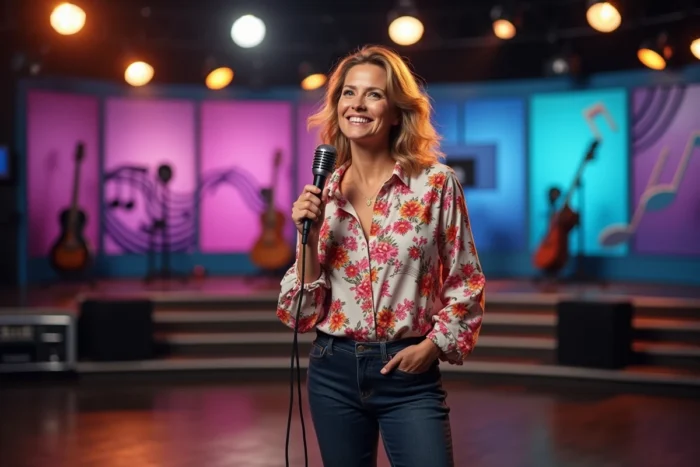
Elsa Fourlon is one of those session musicians whose work remains largely underestimated by the general public. Her role within the Zikos of N’oubliez pas les paroles goes beyond simple instrumental execution, and the way she manages the boundary between television exposure and family life deserves attention.
Editorial Line of France 2 and Separation of Private Life on Set
The production of N’oubliez pas les paroles applies an unwritten rule that distinguishes this program from most entertainment shows: no segment dedicated to the personal lives of musicians is integrated into the editing. No filmed portraits backstage, no asides about family, no storytelling around parenthood.
This strict framing explains why Elsa Fourlon’s journey in N’oubliez pas les paroles remains focused on her musical contribution. We observe here a rare editorial choice in the French audiovisual landscape, where variety shows tend to personalize each participant to create attachment.
For the Zikos, the logic is reversed. The group functions as a collective entity in service of the game. The identity of each musician comes after the coherence of the set.

Elsa Fourlon and Managing Questions About Her Children
Elsa Fourlon has never publicly confirmed or denied the number or existence of her children in verifiable interviews. No first names, no identifying photos, no details about their ages appear on her official accounts or in reliable sources.
This deliberate silence contrasts with the norm in the television industry. Pages claiming to provide accurate information about her life as a mother rely on commentary or rumors, not on established facts. This is a point that most mainstream articles do not dare to articulate so clearly.
Why This Choice of Discretion Works
In a context where television personalities are regularly asked about their parenting, refusing to comment is a protective strategy that has a professional cost. Less personal content means fewer media outlets covering her, less tabloid press coverage, and thus reduced visibility outside the program.
Elsa Fourlon seems to accept this compromise. Her media presence is almost exclusively limited to her role as a musician, which is consistent with the editorial positioning of the show described above.
Instrumental Journey and Versatility within the Zikos
Her integration into the Zikos group at the start of September 2024 on France 2 is not anecdotal. The format of N’oubliez pas les paroles imposes a particular technical constraint on musicians: to perform live a repertoire that spans several decades of French and international songs, with quick transitions between titles.
Elsa Fourlon masters several instruments, from guitar to percussion. This versatility meets a concrete need from the production:
- The Zikos must be able to adapt the arrangement of a song in a matter of seconds according to the candidate’s choice, which requires solid sight-reading skills and a capacity for structured improvisation.
- The transition from one instrument to another live, without a safety net, demands a physical and mental preparation that the viewer does not perceive.
- Past collaborations with established artists (mentioned in her background) serve as an indicator of stage reliability, a decisive criterion for Nagui and the musical direction.
The ability to sustain a daily set over time distinguishes television musicians from studio or touring musicians. The recording pace of N’oubliez pas les paroles, with several shows per day during filming sessions, imposes an endurance that few formats require.

Collective Dynamic of the Zikos and the Real Role of Session Musicians
Nathalie Loriot, a historical figure of the group, has publicly discussed the atmosphere within the Zikos. The team has experienced changes in composition over the years, but the functioning remains that of a seasoned stage group, not an interchangeable session orchestra.
The arrival of Elsa Fourlon fits into this continuity. Each new musician must integrate into an already established collective mechanism, with its codes, playing habits, and non-verbal automatisms developed over hundreds of shows.
What the Camera Does Not Show
The television framing of N’oubliez pas les paroles prioritizes the candidate and Nagui. The musicians appear in cutaway shots, rarely in prolonged fixed shots. This representation diminishes their actual contribution to the program.
In practice, the Zikos perform several simultaneous functions:
- Maintaining the tempo and energy of the set between game sequences, including during commercial breaks.
- Reacting in real-time to candidates’ hesitations or mistakes, adjusting volume and arrangement to support without betraying the response.
- Contributing to the overall atmosphere that Nagui orchestrates, with spontaneous interactions that are not scripted but require a fine reading of the moment.
Elsa Fourlon, through her media discretion and instrumental versatility, fits the typical profile of a session musician who prioritizes the craft over fame. Her personal life remains a subject on which no reliable source can comment, and this is precisely what makes her approach consistent with the framework of the show.
The real issue for those interested in the behind-the-scenes of N’oubliez pas les paroles is not so much what Elsa Fourlon shares about her life as a mother, but what her silence says about the relationship between television exposure and the protection of private spheres in French entertainment.