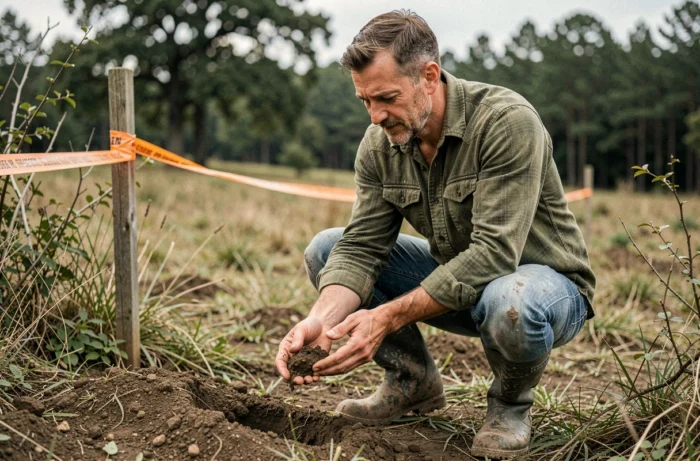
A plot for living autonomously is defined by its ability to provide water, energy, and food without a permanent connection to public networks. Finding this parcel involves crossing technical criteria (soil quality, hydrology, sunlight) with administrative constraints that evolve each year. The project begins with a careful reading of the territory, not with a classic real estate search.
Check climate risk and soil status before any visit
Most autonomy guides address water and sunlight as givens. The blind spot, often, concerns the climate hazard of the land. In recent years, the increase in drought episodes and the phenomenon of shrink-swell clays in France has made this preliminary diagnosis essential.
Even before visiting a parcel, public risk maps (available on Géorisques) allow you to visualize exposure to flooding, landslides, and rising groundwater. A plot located in a clay area can crack in summer and saturate with water in winter, which compromises both the foundations of a lightweight habitat and vegetable cultivation.
The type of soil also conditions sanitation. For a plot not connected to the sewer system, the SPANC (Public Service for Non-Collective Sanitation) requires a soil study that determines the authorized system. A soil that is too impermeable or too permeable can make non-collective sanitation technically unfeasible, and this is discovered after purchase if verification has not been done beforehand. Finding autonomy advice on Immo Relax allows for a deeper understanding of this often underestimated step.

Buildability and zero net artificialization goal: what the PLU changes
An agricultural or natural plot sold at an attractive price does not guarantee the right to build on it, nor even to install a removable habitat. The trajectory of zero net artificialization (ZAN) increases pressure on isolated or peri-urban parcels. Local urban planning plans are evolving, and a plot that is buildable at the time of the sales promise may lose this status during the next revision of the PLU.
Three checks are essential before signing:
- Consult the operational urban planning certificate (not just the information certificate) from the town hall to know the real construction rights on the parcel.
- Check if the municipality is engaged in a revision of its PLU, which may modify zoning in the following months.
- Identify any easements (pipeline passage, natural protection areas, historical monument perimeter) that would limit the use of the land.
A plot classified in agricultural (A) or natural (N) zones in the PLU generally does not allow for any residential construction. Some exceptions exist for buildings necessary for agricultural operation, but they require an operator status and a project validated by the departmental commission.
Water resource: distinguish usage rights from physical availability
Having a watercourse at the edge of the land or an old well does not mean having the right to extract freely. The legal regime of water in France distinguishes between groundwater (which belongs to the landowner under certain conditions) and surface water (subject to prefectural authorization beyond a certain volume).
A domestic borehole must be declared at the town hall, even for strictly private use. Rainwater harvesting is allowed for irrigation and certain non-food domestic uses, but its use for human consumption remains governed by strict health standards.
To assess the actual resource, one must look beyond the land itself:
- The estimated depth of the local water table, which can be consulted with the BRGM (Bureau de recherches géologiques et minières).
- The seasonal flow rate: a well that provides water in March may be dry in August, especially in areas subject to summer restriction orders.
- The quality of raw water, which may require an expensive filtration system depending on local geology (presence of nitrates, pesticides, or heavy metals).

Rainwater harvesting: actual capacity depends on the roofing
The roof area directly conditions the recoverable volume. A modest roof on a lightweight habitat captures only a fraction of a household’s annual needs. Storage must be sized for dry months, not for average annual rainfall. Planning sufficient tanks to cover two to three months of low precipitation avoids unpleasant surprises.
Self-sufficient vegetable garden: agronomic quality of the land takes precedence over size
The temptation is to buy large. A vast plot with poor, stony soil or contaminated by decades of intensive farming requires years of restoration before producing properly. It is better to have a more modest parcel with deep, well-drained soil and a known agricultural history.
Requesting the historical usage of the land (previous crops, phytosanitary treatments) from former operators or the local agricultural chamber provides valuable insight. The proximity of parcels in intensive conventional agriculture poses a risk of pesticide drift, a factor rarely mentioned in real estate listings.
The orientation of the land and the presence of hedges or reliefs influence the microclimate. A vegetable garden facing south but exposed to the prevailing wind without protection will produce less than a slightly less sunny but sheltered plot. The self-sufficient vegetable garden should be thought of as an ecosystem, not just a space to fill.
Solar energy and access to the land: two linked constraints
The installation of solar panels requires a favorable orientation (south, southeast, or southwest) and the absence of solar masks (tall trees, relief, neighboring buildings). A wooded plot provides firewood but reduces photovoltaic potential. This compromise between solar energy and wood resource should be resolved according to the project’s priorities.
The accessibility of the land also conditions the cost of work. A plot served by a non-drivable path complicates the delivery of materials and the intervention of professionals for drilling or sanitation. Isolation has a real logistical cost.
The ideal land for living autonomously does not exist as an abstract data point. It is constructed at the intersection of healthy soil, verified building rights, a sustainable water resource, and usable sunlight. The cheapest parcel in the land registry is almost never the most suitable for a sustainable autonomous project.