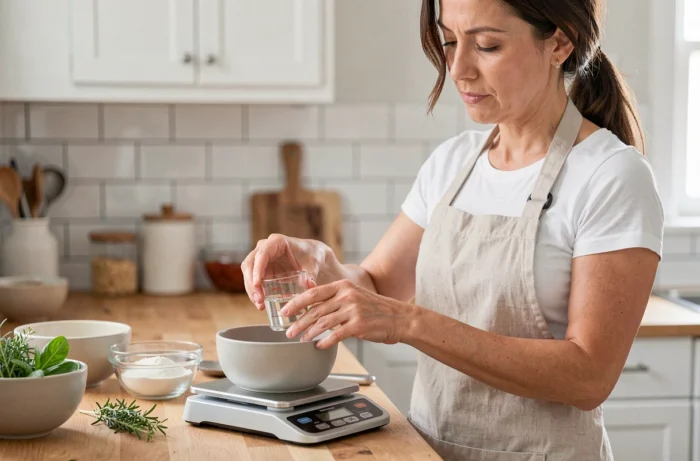
One centiliter of water weighs ten grams, but one centiliter of olive oil weighs only about nine. This difference in density between ingredients changes everything when trying to accurately measure fats or liquids in the context of light cooking. Understanding the conversion from cl to grams means first admitting that volume and weight are not interchangeable, and that each ingredient imposes its own ratio.
Density of common ingredients: the factor that light recipes overlook
The density of a liquid is its mass per unit of volume. Water serves as a reference: its density is 1, which means that one centiliter weighs exactly ten grams. All other liquids deviate from this value.
Oil, a critical ingredient in diet cooking, has a density lower than 1. One centiliter of oil weighs about nine grams. The difference may seem minimal, but in a vinaigrette measured at five centiliters, the gap already reaches several grams, which is a significant caloric surplus when monitoring fat intake.
Semi-skimmed milk, on the other hand, is close to water with a slightly higher density. Thick fresh cream is denser, while honey, often used as a sugar substitute in light recipes, clearly exceeds the density of water. Mastering the conversion from cl to grams for each of these ingredients allows for calculating the actual contributions of a dish, not those that the measuring cup might suggest.

Conversion table from cl to grams for light cooking liquids
Rather than multiplying searches for each recipe, a correspondence table for the most common liquids in diet cooking simplifies the task. Here are the equivalents for one centiliter, to be multiplied according to the necessary amount.
| Ingredient | 1 cl (in grams) | 10 cl (in grams) |
|---|---|---|
| Water | 10 g | 100 g |
| Semi-skimmed milk | ~10.3 g | ~103 g |
| Olive oil | ~9.2 g | ~92 g |
| Light fresh cream (15 %) | ~10 g | ~100 g |
| Vinegar | ~10.1 g | ~101 g |
| Liquid honey | ~14 g | ~140 g |
Honey weighs significantly more than water at equal volume. Replacing sugar with honey while relying solely on centiliters in a recipe skews the caloric calculation. Weighing it on a scale remains the reliable method.
Scale or measuring cup: which tool for reliable dietary tracking
The measuring cup measures a volume. The scale measures a weight. In light cooking, the scale prevails for controlling calories, because nutritional databases (those used by tracking apps like Cronometer or MyFitnessPal) express most values in grams, not in centiliters.
Using a measuring cup for oil, for example, amounts to estimating weight from volume. The approximation is acceptable for water or milk, whose density is close to 1, but it diverges for fats and thick liquids.
Spoons as quick dosage references
In the absence of a scale, spoons offer a practical compromise for small quantities:
- A level tablespoon corresponds to about 1.5 cl, or about fifteen grams of water or thirteen grams of oil.
- A level teaspoon represents about 0.5 cl, or five grams of water.
- A standard yogurt pot contains about 12.5 cl, which equals one hundred twenty-five grams of water.
These references work for emergencies, but they do not replace weighing when the recipe targets a precise caloric intake.

Why calorie tracking photo apps do not replace weighing in light cooking
Apps that estimate the calories of a meal from a photo are multiplying. Their promise: scan your plate and get a nutritional report without weighing anything. In practice, these tools underestimate the calories of meals containing fats.
The reason is directly related to the cl/gram conversion issue. A photo does not capture the actual amount of oil added to a pan, nor the density of the liquid. The algorithm sees a dish, not the three centiliters of olive oil (about twenty-eight grams, or over two hundred kilocalories) that were used for cooking.
For light cooking, where every gram of fat counts, weighing remains the necessary step. The most reliable nutritional tracking apps incorporate databases that automatically convert grams and portions, but they assume that the user inputs actual weights, not visual estimates.
Conversions in light baking: flour, sugar, and liquids in the same recipe
Light baking complicates the subject further, as it mixes solid ingredients (flour, powdered sugar) and liquids (milk, water, oil) in tight proportions. Flour, although solid, is often measured in cups or tablespoons in Anglo-Saxon recipes, which necessitates a conversion to grams for reproducible results.
Packed flour in a cup weighs much more than aerated flour. The so-called “scoop and level” method gives a different weight each time. Weighing flour on a scale eliminates this variable and ensures the texture of the lightened cake.
Adjusting proportions to reduce calories
When a baking recipe calls for twenty centiliters of full cream, replacing it with light cream changes the total weight (light cream is less dense than full cream) and reduces fat intake. The same reasoning applies to replacing butter with applesauce: the densities differ, the grams obtained for the same volume differ, and the result in taste does too.
- Replace oil with applesauce: adjust the weight, not the volume, because applesauce is denser than oil.
- Substitute full cream with cottage cheese: weigh the target amount rather than measuring it in centiliters.
- Reduce sugar by using honey: divide the volume by about 1.4 to achieve the same sweetening power in grams.
The most reliable reflex in light cooking remains to convert each ingredient to grams before starting, then calculate the total caloric intake based on these actual weights. A kitchen scale, even the most basic, offers a precision that neither the measuring cup nor visual estimation can achieve.