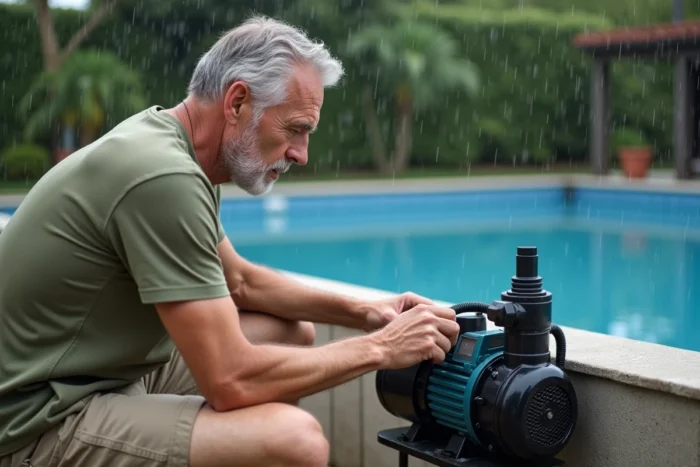
The pool pump ensures the continuous circulation and filtration of water. When rain sets in, the temptation to turn off the system to protect it seems logical. However, the answer depends on the type of pump, the intensity of the precipitation, and the electrical installation of the technical room.
Filtration in the rain: what the motor really endures
An in-ground pool pump, installed in a closed technical room, is not afraid of a typical downpour. The motor is sheltered, the hydraulic connections are watertight, and the rain that falls into the pool simply mixes with the existing water.
The problem arises through another mechanism. Heavy rain brings debris (leaves, dirt, insects) towards the skimmers. If the skimmer basket becomes clogged, the suction flow drops. The pump continues to run but no longer receives enough water, causing a phenomenon called cavitation: small air bubbles implode in the turbine, generating whistling sounds and prematurely wearing out the bearings and mechanical seal.
It is therefore more useful to monitor the condition of the pre-filter and skimmer during a rainy episode than to simply cut the power. Knowing how to protect the pool pump from the rain starts with this vigilance over the suction circuit.
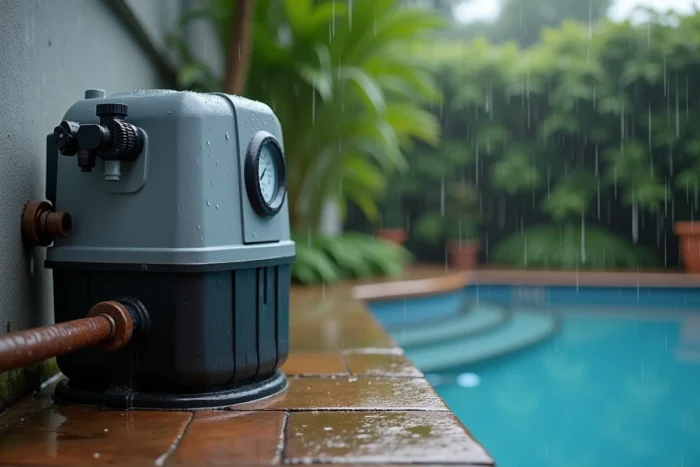
Above-ground pool pump: a contractual obligation to unplug
The situation changes radically for tubular or self-supporting pools. The manuals of many pumps supplied with above-ground pools (Bestway, Intex, and similar brands) explicitly require unplugging the pump in case of rain. This instruction is not just a simple precautionary advice.
Failure to comply with this instruction can lead to the loss of the manufacturer’s warranty. These small pumps do not have the same electrical protection as a filtration unit installed in a dedicated technical room. Their casing, often placed directly on the ground near the pool, does not provide sufficient waterproofing against water splashes or rising ground levels.
Electrical risk and grounding
Beyond the warranty, the main risk remains electrical short-circuit. An above-ground pump connected to a simple outdoor outlet, without a dedicated residual current device, poses a real danger in case of water-current contact. The correct reflex: unplug before the downpour, then wait for the ground around the pump to dry before plugging it back in.
Thunderstorm and lightning: stop the pump without hesitation
Whether in-ground or above-ground, the rule changes as soon as a thunderstorm is forecast. Lightning can cause a surge in the domestic electrical network, capable of frying the pump motor, the electrical box, or even the entire filtration system.
A surge protector installed on the electrical panel reduces the risk, but does not eliminate it entirely. The most reliable precaution remains to cut the circuit breaker dedicated to the pool circuit at the first signs of a storm.
- Cut the circuit breaker for the pool circuit (not just the pump switch) to isolate the entire system from the surge
- Avoid touching the pool water or metal equipment during the storm
- Wait for the storm to completely pass before restarting the filtration

Water level and pool chemistry after the rain
The rain alters two parameters that the pump alone cannot correct: the water level in the pool and the chemical balance.
Level control at the skimmer
After a prolonged rainy episode, the water level rises. If it exceeds halfway up the skimmer, its efficiency in skimming decreases: floating debris is no longer properly sucked in. A partial drain may be necessary to bring the level back within the optimal operating range.
Conversely, a violent storm followed by rapid evaporation or overflow can cause the level to drop below the skimmer threshold. The pump then sucks in air, which brings back the cavitation problem mentioned earlier.
Impact on chlorine and pH
Rainwater is naturally acidic (pH often close to 5.5 to 6). A massive influx dilutes the residual chlorine and lowers the pool’s pH. Quickly restarting filtration after the rain helps to mix the water and homogenize the treatment, but manual chemical adjustment remains essential.
- Test the pH and chlorine levels as soon as the rain stops, before restarting filtration
- Clean the pump’s pre-filter and skimmer basket to remove accumulated debris
- Visually check for any air leaks on the suction connections (bubbles in the pump sight glass)
- Restart filtration for a complete cycle to treat the added water volume
When filtration should continue despite the rain
Stopping the pump during moderate rain on a well-protected in-ground pool brings no technical benefit. On the contrary, keeping filtration active prevents stagnation and limits the development of algae favored by the influx of organic matter and the decrease in disinfectant.
The only situation that justifies a systematic stop is a thunderstorm, or the use of an above-ground pump whose manual requires unplugging. For in-ground installations with a watertight technical room and electrical protection up to standards, turning off the pump at each downpour leads to multiple restart cycles, which stresses the motor more than continuous operation.
The best protection for a pool pump in the rain is not the stop button. It is a clean pre-filter, a clear skimmer, a suction circuit without air intake, and a functioning residual current device on the electrical panel.