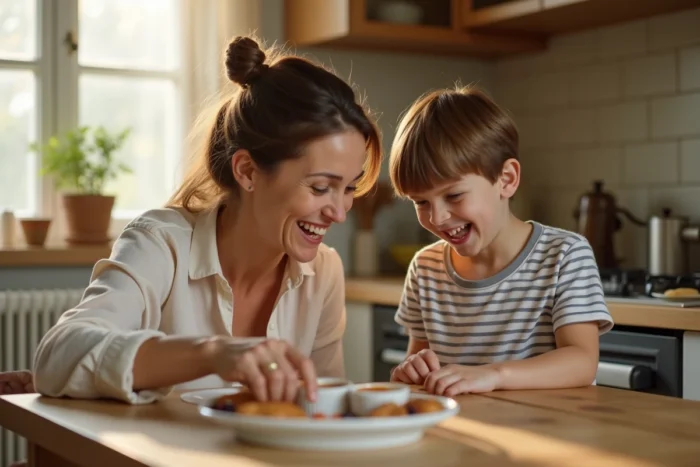
Family kindness is not just about lowering your voice when a conflict arises. We observe that families that maintain a stable relational climate on a daily basis share a common point: they have established collective emotional regulation mechanisms, not just individual ones. This topic deserves a technical reading, beyond the usual positive injunctions.
Parental emotional regulation: the lever that family guides underestimate
A parent who identifies their own emotional triggers before reacting changes the dynamics of the entire family unit. Parental anger, for example, is not a “stress management” issue: it is a physiological signal that requires precise interpretation.
We recommend mapping your triggers over a full week. Note the time, context (fatigue, hunger, cognitive overload), and the reaction adopted. This observational work, used in structured parental support, helps identify recurring patterns. The parent’s emotional regulation precedes that of the child, not the other way around.
The Family Allowance Funds have strengthened the system of the Promeneurs du Net, professionals who support parents and young people via social networks in a logic of kind and non-intrusive support. This type of resource, available for free, provides a framework to work on these issues with a third party, without waiting for a crisis. Addressing the family with Maman du Quotidien also helps structure parental reflection through content designed for everyday life.
Kind communication in the family: going beyond mechanical reformulation
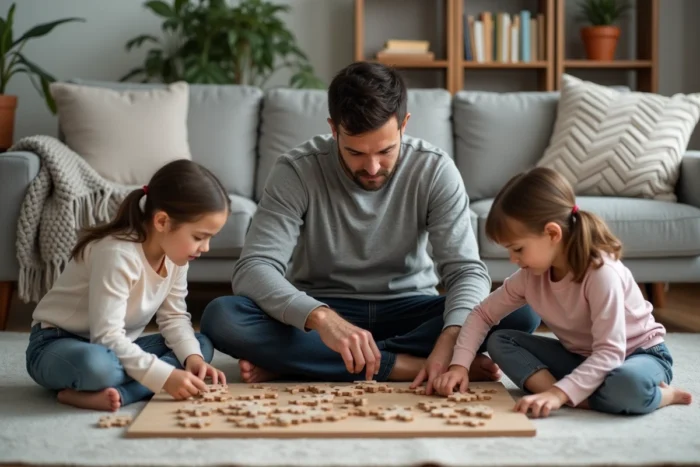
Kind communication is often reduced to a reformulation technique (“You feel frustrated because…”). This approach, if applied mechanically, loses all relational effectiveness. Children quickly pick up on the process and stop responding.
Listening without immediately seeking to solve changes the quality of the exchange. When a child expresses an emotion, the parental reflex is to propose a solution. Suspending this reflex, even for thirty seconds, creates a space for speech that the child invests differently.
Three markers of truly active listening
- Maintaining eye contact without verbal interruption while the child speaks, even when their words seem incoherent or exaggerated.
- Emotional reformulation (naming the perceived emotion) rather than factual (summarizing the event), which validates the feeling before the narrative.
- The absence of implicit judgment in body posture: uncrossed arms, position at the child’s height, stable tone of voice.
These markers are not innate. They are trained, ideally by practicing them first among adults in the household. Parents who listen to each other with these codes effortlessly pass them on to their children.
Daily family rituals: creating reference points without rigidity
Family rituals are not logistical routines. A ritual carries a symbolic dimension: it says something about the identity of the family group. Shared dinners without screens, a roundtable of “highlights” from the day, or a common reading time before bed serve this function.
We observe that families that maintain their rituals over time share a characteristic: the ritual is short, enjoyable, and non-negotiable. Ten minutes is enough. Regularity matters more than duration.
Adapting rituals to age without reinventing everything
A three-year-old needs a sensory ritual (lullaby, hug, tactile story). An eight-year-old prefers a participatory ritual (choosing the weekend menu, sharing an anecdote). A teenager accepts a discreet ritual (a kind note slipped into their bag, a moment shared over a series).
The common trap is to maintain a ritual that has become unsuitable out of parental nostalgia. A ritual that generates resistance has lost its linking function and should be replaced, not imposed.
Gratitude and positive emotions: an underused parental tool
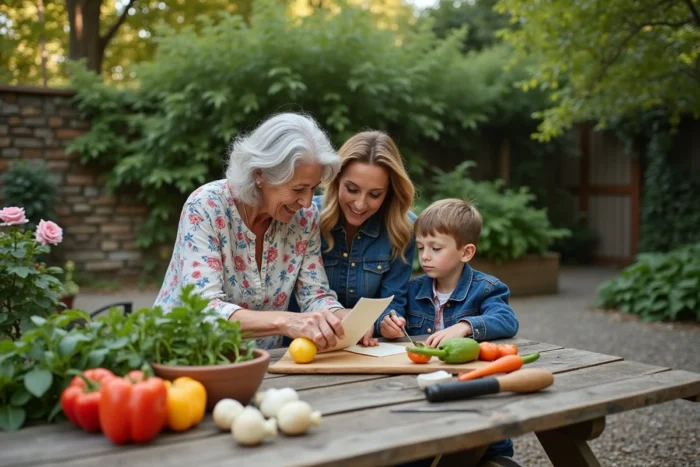
Expressing gratitude in the family is not a personal development exercise. It is an attention reframing tool that concretely changes the family climate. When each family member names a positive element of their day, the brain trains to spot what works rather than what is dysfunctional.
The setup is simple: a daily roundtable where everyone mentions a pleasant moment, an action by another family member they appreciated, or a personal achievement. The exercise takes less than five minutes.
- Start with the adults to set an example and ease any potential discomfort in the children.
- Accept minimalist responses (“my snack”) without seeking deep answers, especially at first.
- Never correct or comment on the gratitude expressed by another, even if it seems trivial.
This practice, when it becomes regular, changes spontaneous interactions among family members. Complaints decrease, positive formulations increase, without anyone feeling like they are making a particular effort.
Several local authorities have recently developed an explicit policy to support parenting that includes the issue of family climate and conflict prevention. These local initiatives (family mediation, psychological support, assistance with procedures) directly aim at the quality of daily relationships. Family kindness is no longer a private matter but a public policy issue.
Building a kind family daily life relies on concrete, reproducible, and adjustable mechanisms over time. Parental emotional regulation, structured active listening, age-appropriate rituals, and the practice of gratitude form a foundation that can be worked on like any skill. The framework evolves, children grow, needs change: families that endure are those that accept revising their tools without abandoning the intention that drives them.